Website Redesign
Jiva Naturals
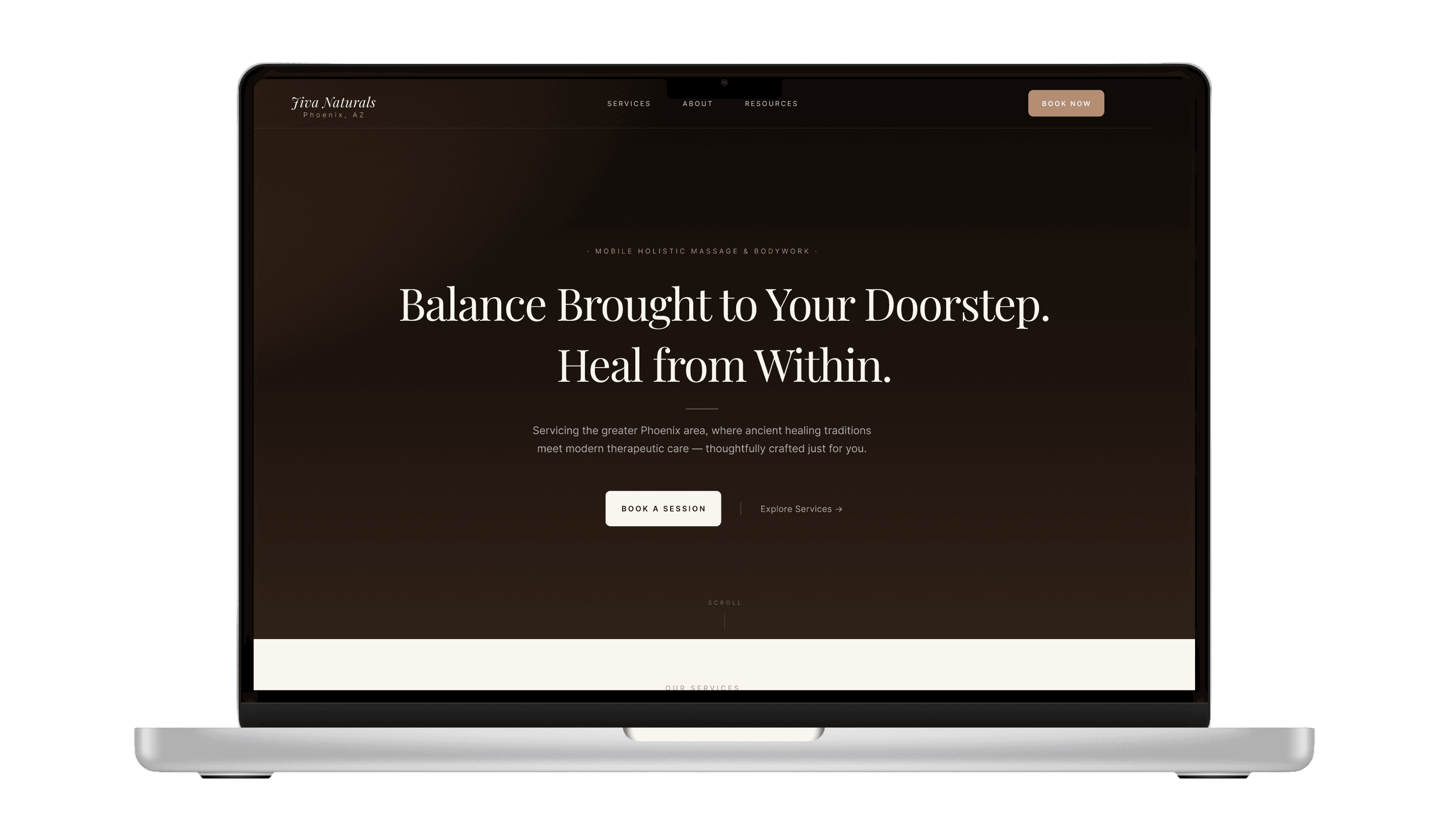
A single-page website for a mobile holistic massage therapy business in Phoenix, AZ — designed for clarity, trust, and conversion with an audience of primarily older adults.
Timeline: 1 Weeks · Tools: Figma, Framer, Claude · Solo Project
Overview
Jiva Naturals is a mobile holistic massage therapy business serving the Phoenix, AZ area. As a mobile operation, their biggest advantages are convenience and accessibility — they come to the client, removing any barrier around travel or accessibility. The existing web presence didn't communicate that clearly, and the business needed a site that could do the selling for them.
The primary goal was a conversion-focused landing page: get visitors to book a session. The client already used PocketSuite for scheduling, so the site needed to connect to that existing flow rather than reinvent it — keeping the scope lean and the cost low.
TLDR (Summary)
Jiva Naturals is a mobile holistic massage therapy business in Phoenix whose existing web presence wasn't doing the work it needed to do. As a solo project, I designed and built a single-page conversion website in Figma and Framer — lean by intention, since budget was a real constraint and a focused one-page layout meant lower cost, faster load times, and less maintenance burden for a small business owner.
The design was shaped by two things: the audience and the goal. With a clientele that skews older, every decision prioritized clarity over cleverness — generous whitespace, soft typography, minimal animation, and a page structure that answers each visitor's next logical question as they scroll, ending at a single obvious call to action. When the client pushed for a pink and purple palette, I brought competitor sites into the conversation instead of pushing back directly — letting the market landscape make the case. They made the shift on their own terms, which meant stronger buy-in on the final design. The biggest takeaway: in client work, showing is almost always more effective than telling.
The Process
01 - Constraints & Decisions
Why One Page, and Why Framer
Budget was a real constraint. Rather than build a multi-page site that would drive up both development time and hosting cost, I made the case for a focused single-page layout — one page means lower cost, faster load times, and a simpler maintenance burden for the client.
I chose Framer as the build platform because it's well-suited to design-forward sites with simpler needs. Framer's free plan covers sites like this one, making it a practical fit for a small business. It also gave me tight design control without requiring a custom codebase — and since the client's booking process already lived in PocketSuite, there was no need for additional pages or a built-in booking flow.
02 - Audience & Approach
Designing for Older Adults
Jiva Naturals' clientele skews older, which shaped nearly every design decision. This audience tends to favor clarity over cleverness — they want to quickly understand what the business offers, where it operates, and how to book. Anything that gets in the way of that is a liability.
Design principle: Focus. A minimalist, conversion-centered approach that removes distractions and keeps the visitor's attention on a single next action — booking a session.
I kept animations minimal and purposeful. Scroll-triggered effects and decorative motion can disorient older users and slow down the experience on older devices. The priority was readability: generous whitespace, soft elegant typography, and sufficient contrast throughout. Rounded corners and organic shapes reinforced the holistic, natural character of the brand while also feeling approachable rather than clinical or corporate.
03 - Structure & Content Strategy
The page structure follows what I think of as a question-and-answer flow — each section is positioned to answer the next logical question a visitor would have as they scroll.
Design principle: Flow. Information is sequenced to mirror the visitor's mental journey, reducing cognitive load and guiding them naturally toward a decision.
1
Hero — "What is this?"
Immediately establishes the business, its location, and the at-home service model. The mobile, come-to-you advantage is front and center — it's the differentiator that matters most to this audience.
2
Services — "What do they offer?"
Answers the first follow-up question. Each service is presented with enough context to help the visitor understand their options — not just a price list, but a genuine explanation of what each session involves.
3
About — "Why should I choose them?"
Builds trust by introducing the practitioner and their background. For a personal service business, this section carries a lot of weight — people want to know who is coming to their home.
4
Testimonials — "Can I trust this?"
Social proof placed after the about section, where the visitor's trust is already warming. Real client reviews reinforce credibility at the moment they're most likely to convert.
5
CTA — "How do I book?"
A clear, high-contrast call-to-action that links directly to PocketSuite. No friction, no new tabs to navigate — just a single obvious next step.
04 - Visual Design
Color, Typography, & Brand Pivot
The client initially requested a pink and purple color palette. Rather than push back directly, I brought competitor sites into the conversation and walked them through the visual landscape of the holistic wellness space. Seeing how earthy, nature-inspired palettes dominated the market — and how much more aligned that felt with the "holistic" energy they wanted to project — the client made the shift themselves.
The final palette draws from warm, organic tones: muted greens, warm neutrals, and soft terracotta accents. Color was also used strategically — higher-contrast areas naturally draw the eye toward key conversion points like the CTA, while softer tones recede into the background and let the content breathe.
Typography is soft and elegant, chosen to feel calming rather than corporate. Generous whitespace throughout gives the design room to feel premium and unhurried — appropriate for a wellness brand and accessible for an older audience.
Playfair Display Header
This the body style font, called inter.
Primary
Secondary
Accent
Alt
05 - Challenges
Along the Way
Pricing layout that doesn't feel like a menu
The services section went through several iterations. The first version listed each service with a price inline — it worked functionally, but visually it read like a restaurant menu, which felt out of place for a wellness brand and gave visitors no real sense of what each service entailed. I redesigned the layout to give each service its own card with a description, letting the pricing sit within that context rather than lead with it. The result is easier to scan and helps visitors make a more informed decision before clicking through to book.
Working Without Studio Photography
Because Jiva Naturals is a mobile business, there are no studio photos — no treatment room, no branded space to photograph. I had to design a visual experience that felt warm and professional without leaning on imagery as a crutch. The solution was to use fewer, more intentional photos and let the typography, color, and whitespace carry the visual weight of the page. This actually reinforced the minimalist design direction rather than compromising it.
06 - Reflection
Takeaway
The brand color conversation was a good reminder that showing is more effective than telling. Rather than presenting my recommendation as a correction, I let the competitive landscape make the case — the client arrived at the right decision on their own terms, which meant stronger buy-in on the final design.
Designing for an older adult audience pushed me to be more intentional about hierarchy and restraint. Every element on the page had to earn its place. That discipline made the design better across the board, not just for the target demographic.
If I were to revisit this project, I'd want to run usability testing with actual users in the target age range — even informal sessions would surface friction points that are hard to anticipate from within the design process.

© 2025 · Sydney Hendrix